
A Practical Budget Guide for School Promoters (2026)
Every school promoter asks the same question sooner or later: “How much will it cost to build my school?”
There isn’t a single answer and, in my experience, the promoters who get into the most trouble are the ones who go looking for one.
The cost of building a school depends on many factors: the size of the campus, the facilities you want to provide, the quality of construction, the choice of materials, the construction technology, and the project location. Two schools with the same built-up area can have very different budgets, because every school’s vision is different.
Having designed schools across India for more than 25 years, I’ve found that the biggest budgeting mistakes are usually made before construction even begins. Good planning at the start saves both time and money later.
This guide is meant to help school promoters understand what actually drives the cost of building a school, plan realistic budgets, and avoid the financial mistakes I see repeated most often.
Why There Is No Standard Cost for Building a School
Unlike residential or commercial buildings, no two schools are alike. Some are planned with only the essential academic facilities; others include auditoriums, indoor sports halls, swimming pools, innovation labs, performing arts spaces, hostels, and large outdoor sports facilities. Naturally, the costs are very different.
This is why comparing schools purely on a cost-per-square-foot basis can be misleading. It’s a useful benchmark, but it doesn’t tell the complete story.
Instead of asking “What is the cheapest way to build a school?”, a better question is:
“What is the right investment for the kind of school I want to build?”
Five Factors That Influence School Construction Cost
1. Size of the School
Size has a direct impact on overall project cost, but larger schools are generally more efficient, because facilities such as the library, laboratories and administration block are shared by more students. A school planned for 2,500 students typically needs proportionately less area for common facilities than one planned for 800.
The size of the plot matters, too. Larger sites need greater investment in roads, pathways, landscaping, boundary walls and drainage, but they also benefit from economies of scale: bulk procurement and better resource utilisation often reduce the construction cost per square foot.
2. Facilities Offered
The first step in planning any school is defining its vision clearly. Once that’s set, the required facilities follow.
A school with only classrooms, labs and admin spaces will have a very different budget from one that also includes a multipurpose hall, music and dance rooms, indoor sports, dining areas and innovation labs. A day-boarding school adds dining and kitchen facilities on top of that.
Sports infrastructure, in particular, has become a major budget driver. An outdoor swimming pool, a covered or temperature-controlled pool, indoor sports halls, football fields, tennis courts and synthetic surfaces all sit at very different price points, and many new-age schools now offer 15 to 20 different sports within one campus.
The key is to prioritise facilities that support the school’s vision and educational objectives, rather than trying to include everything in the first phase.
3. Construction Materials and Finishes
Flooring, classroom finishes, staircase finishes, toilet fixtures, doors, windows and façade materials may look like small line items individually. Together, they account for a substantial share of the budget.
The façade deserves particular attention. A simple plaster-and-paint finish costs less upfront but needs periodic repainting and maintenance. Natural stone, tiles or other durable cladding cost more initially but need far less upkeep over the life of the building.
At BASICS Architects, we often compare the higher initial investment with the long-term maintenance savings before recommending a solution, and often a slightly higher capital cost delivers a lower lifecycle cost and better long-term value.
At DBDS Shriram School in Kota, we found high-quality local stone readily available near the site. Rather than importing material from elsewhere, we used locally sourced stone masonry which cut transportation costs and gave the campus a strong regional character.
Since school buildings are meant to last for decades, material choices should be judged on durability and lifecycle cost, not just the price tag on day one.
4. Project Location
Construction costs vary across India due to differences in labour availability, material costs, transportation and local market conditions. The cost of building a similar school can vary meaningfully between Delhi, Jaipur, Lucknow, Bengaluru or a Tier-2 city.
At the same time, location can also create opportunities to reduce costs. The Kota example above is really a location story as much as a material one.
5. Site Conditions and Structural Costs
Every site presents its own challenges, and these can significantly move the budget.
If a site is low-lying, significant earth filling may be needed before construction even begins on one of our projects. We had to fill the site by nearly three feet to reach the required levels, adding substantial cost before the building work started.
Structural costs are shaped by a few recurring factors:
- Earthquake zone – Schools in higher seismic zones need stronger structural systems to comply with the National Building Code (NBC) and relevant seismic standards, which generally increases the quantity of steel and concrete required.
- Soil conditions – Weak or sandy soil often needs deeper or more specialised foundations. We’ve worked on projects where poor soil conditions significantly increased foundation cost.
- Building height – Taller buildings need stronger structural systems and more vertical circulation; very low-rise buildings need a larger footprint and more site development. In many cases, a G+2 or G+3 building strikes a good balance between construction cost, land utilisation and operational efficiency, though the right call always depends on the site, local regulations and the school’s own requirements.
What Is the Average Cost of Building a School in India?
Every project is unique, but promoters need a starting point for financial planning. The figures below are broad budgeting guidelines for the early planning stage, not fixed rates.
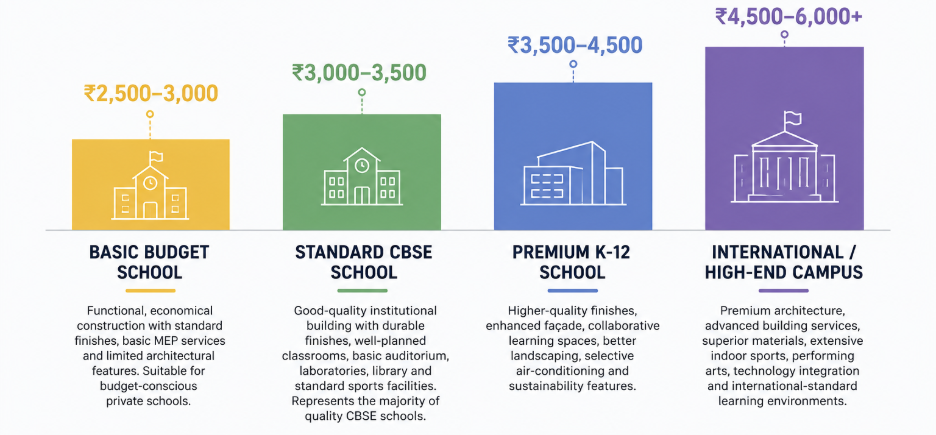
Indicative School Construction Cost Per Sq. Ft. (2026)
Note – Excludes land cost, statutory approvals and government fees, GST, equipment and fixtures, utility connections and financing costs. MEP includes electrical, mechanical (including air conditioning), water supply, plumbing, and fire-fighting services.
Where Does the Budget Actually Go?
One of the most common misconceptions is that most of the project budget goes into constructing the school building. In reality, the building is only one part of the investment – building services, sports facilities, external development, furniture, IT infrastructure, professional consultancy and statutory approvals all need to be funded before a campus is ready to function.
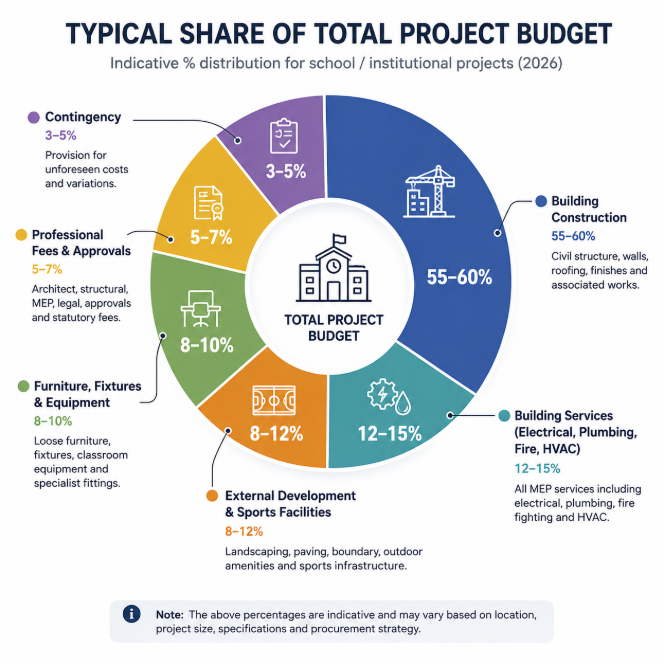
For example, on a ₹25 crore development budget, around ₹13–15 crore typically goes into constructing the buildings; the balance goes towards creating a complete, functional campus.
Costs that are often overlooked at the budgeting stage:
- Furniture for classrooms, laboratories, the library and administration
- IT infrastructure, networking and smart classroom systems
- Site development, landscaping and internal roads
- Boundary walls, gates and security systems
- Statutory approvals and government fees
- Water supply, electrical connections and utility infrastructure
- Signage and wayfinding
- Professional testing and certifications
- Contingency for unforeseen expenses
Accounting for these from day one leads to a more realistic budget and far fewer surprises during construction.
How to Control Costs Without Compromising Quality
Controlling costs does not mean cutting corners. In our experience, the biggest savings come from good planning, not from compromise.
1. Plan thoroughly before construction begins. The planning stage has the biggest influence on overall cost. Finalise the design, understand the budget and prepare detailed drawings before construction starts, and review costs regularly once it does. Frequent design changes mid-construction is one of the biggest reasons projects run over budget.
2. Build in phases. Not every facility needs to be built on day one. Many successful schools start with the essential academic and administrative facilities and add auditoriums, sports complexes and specialised spaces as the school grows, as long as future expansion is planned for from the beginning, so it doesn’t require expensive alterations later.
3. Design efficiently. Every square foot cost money. A well-planned building uses space efficiently through smart layouts, good circulation, and sensible structural planning without compromising the learning environment.
4. Think beyond the initial construction cost. Natural daylight, cross ventilation, durable materials and energy-efficient systems may cost slightly more upfront, but they reduce maintenance and operating costs for decades. Schools are built to last; decisions should be judged on lifecycle cost, not just day-one cost.
Common Budgeting Mistakes
- Focusing only on the building cost. External development, furniture, IT infrastructure, statutory approvals, and other essential costs are often underestimated or left out entirely.
- Trying to build everything in the first phase. Including every possible facility from day one puts unnecessary pressure on the budget. A phased approach usually lets a school grow more comfortably as student strength increases.
- Choosing the lowest quote. The lowest cost isn’t always the best value. Quality of materials, workmanship, and long-term maintenance cost matter just as much when selecting a contractor.
- Not budgeting for contingencies. Every construction project hits the unexpected. A reasonable contingency provides flexibility and avoids financial stress mid-construction.
The most successful school projects aren’t necessarily the ones with the biggest budgets; they’re the ones that are well planned from the beginning, with a clear vision, realistic budgeting and disciplined execution.
Final Thoughts
Building a school is a major investment, and construction cost is an important consideration, but it should never be looked at in isolation. The goal isn’t to build the cheapest school. It’s to build the right school within the available budget.
A well-planned school balances vision, functionality, quality and cost. It avoids expensive changes mid-construction and delivers better value over the life of the campus. The earlier you start planning, the better decisions you can make. Understanding the complete project budget before construction begins is one of the most effective ways to deliver a successful school project.
If you’re planning a new campus and want to think through the numbers before you commit to a design, we’d be glad to talk it through with you.